Streaming Setup Cost UK: The Full Breakdown
UK edition. Written for UK rooms, UK retailers and prices in pounds. The gear reasoning applies anywhere; the dimensions, prices and regulations are UK-specific. Browse all setup guides.
Every streaming cost guide lists cameras, mics and lights. Almost none of them mention the thing most likely to actually stop you streaming in Britain, which is your upload speed.
The short answer
A streaming setup people will actually watch costs £350 to £800 in the UK, on top of a PC that can already play the game. If you have not costed that side yet, what a full gaming setup costs covers it.
Spend it in this order: microphone, lighting, camera. That order is deliberate and it is the reverse of what most beginners do. Before any of it, check your upload speed. No amount of gear compensates for a connection that cannot push a stable stream.
Your upload speed, not your camera
UK broadband is heavily asymmetric. Download figures get all the marketing attention; upload is what streaming actually consumes, and on older copper-based connections it is capped low.
10–20
Mbps upload ceiling on FTTC copper lines, the limit that actually decides this
1 Mbps
Upload floor guaranteed by Ofcom’s USO
78%
UK premises where full fibre is now available (Ofcom, July 2025)
| Stream quality | Upload needed | Realistic on FTTC? |
|---|---|---|
| 720p 30fps | ~3 Mbps | Yes |
| 1080p 60fps | ~6 Mbps | Usually |
| 1440p 60fps | ~10 Mbps | Marginal |
| 4K 60fps | ~20 Mbps+ | No |
Two practical points. Leave headroom: streaming at your absolute ceiling drops frames the moment anyone else in the house opens anything. And run an Ethernet cable if you possibly can; Wi-Fi upload is consistently worse than the wired figure your speed test reports.
USO minimums from Ofcom’s Connected Nations 2025 report (published 19 November 2025), which sets the “decent broadband” floor at 10 Mbit/s download and 1 Mbit/s upload. The average upload figure is not an Ofcom measurement. See the note below. Bitrate requirements are platform guidance rounded to the nearest sensible figure.
Buy in this order, not the other one
Viewers forgive a soft picture. They leave over bad audio within seconds. Almost every beginner buys the camera first anyway.
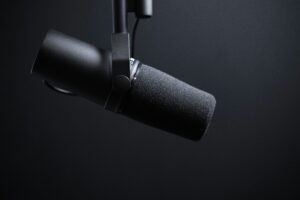
Microphone: £90–£150
The single highest-impact purchase. A dynamic mic close to your mouth rejects the room, the keyboard and the PC fans. This is where your first hundred pounds goes.
Lighting: £60–£180
A cheap camera in good light beats an expensive camera in bad light, every time. British daylight is unreliable enough that this is not optional if you stream in the evening.
Camera: £60–£250
Only now. A decent 1080p webcam is fine; most viewers watch your face in a small corner box. Spending £600 on a mirrorless body plus capture card is a late-stage upgrade, not a starting point.
Everything else: later
Stream decks, green screens, second monitors and capture cards are quality-of-life upgrades. Encoding headroom is not, and how to split a PC budget covers where it comes from. None of them make your stream more watchable to someone discovering you today.
What each budget buys
Getting started
~£200- USB dynamic microphone: £90
- Desk boom arm: £30
- Single key light: £50
- Existing webcam or phone: £0
- Free broadcasting software: £0
Taking it seriously
~£550- XLR dynamic mic plus interface: £230
- Boom arm and cable: £45
- Two-point lighting: £130
- 1080p webcam: £90
- Acoustic panels behind you: £55
The panels are the unglamorous line. An echoey room is the most common reason a stream sounds amateur even with a good mic.
Full production
~£1,400- Mirrorless camera and capture card: £700
- Three-point lighting: £280
- Broadcast mic chain: £300
- Stream controller: £120
Worth it once streaming earns money. Before that, this is buying production value for an audience that does not exist yet.
Straight answers
Do I need a capture card to stream?
Only if you are using a separate camera or a console. If you stream PC games with a webcam, software handles everything and a capture card adds nothing.
Can I stream on my normal broadband?
Usually yes at 1080p. UK average upload sits around 27 Mbps, comfortably above the roughly 6 Mbps a 1080p60 stream needs. Older FTTC copper lines cap upload at 10 to 20 Mbps, which still works but leaves less headroom.
Should I buy a USB or XLR microphone for streaming?
USB if you stream alone, XLR if you will ever have a guest in the room. The connector is a channel-count decision rather than a sound-quality one.
Is a green screen worth it?
Only once your lighting is already good. A green screen in poor light produces worse results than no green screen at all, because the edge keying falls apart.
How much does it cost to stream on console?
Add a capture card, roughly 100 to 200 pounds, since consoles cannot run broadcasting software themselves. Everything else on this page applies unchanged. Running one at a desk raises its own questions, which setting a console up at a desk answers.
How we produced this guide
The USO floor comes from Ofcom’s Connected Nations 2025 report, read directly. The average upload figure needs a caveat we did not previously give it: Ofcom’s SamKnows-measured UK Home Broadband Performance series was discontinued after March 2023, when the last measured median upload speed was roughly 18 Mbit/s. Higher averages quoted for 2025-26 circulate via commercial broadband comparison sites and are not drawn from Ofcom measurement, so we no longer present them as Ofcom figures. The 10–20 Mbit/s FTTC range reflects the upload caps of Openreach FTTC product tiers rather than a measured average, and the full-fibre availability figure is from Connected Nations 2025 (data gathered July 2025). Note that published UK speed averages vary widely depending on whether they measure average maximum, median experience or speed-test samples, so we have used upload figures rather than headline download numbers, since upload is what streaming consumes. Equipment prices are typical UK retail at the time of checking.
We have not tested every product referenced here and do not claim to have. This is analysis built on published specifications, current UK pricing and practical experience of ordinary rooms, not laboratory measurement.
Checked July 2026. Reviewed quarterly.
Written by
Paul
Paul started Setupfind after one too many American gear guides priced equipment he could not actually buy here. He works in digital research and SEO, and spends his own time on music production, including supporting an independent Afrobeats artist, where a session budget is a real number rather than a hypothetical one.
He is not a studio engineer, and this site does not pretend otherwise. What Setupfind offers is disciplined price research, UK-specific context, and a refusal to recommend anything on the strength of a manufacturer’s press release.
Affiliate disclosure: some links on Setupfind earn us a commission if you buy through them, at no extra cost to you. Commission never determines what we recommend.