Built for hour six, not for the photo
Most home office setup advice optimises for how the room looks. This one optimises for how your back feels at 4pm.
realistically starts
the month it was checked
budget against
How long are you actually at this desk?
This one answer changes the order you should spend in. Nearly every uncomfortable home office is a short-day setup being used for a long day.
Under four hours a day
$355 to $615
roughly £263 to £455
- Your chair is furniture, not equipment. Any firm seat at the right height will do.
- Put the money into getting the screen up to eye level instead.
- A 24 inch 1080p monitor is genuinely enough at this length of day.
- Skip the standing desk. You are already getting up often.
Four hours or more
$870 to $1,500
roughly £645 to £1,110
- The chair stops being furniture and becomes the largest single line item.
- Adjustable seat height and armrests matter more than mesh, lumbar gadgets or brand.
- A 27 inch 1440p screen at eye level, on an arm rather than a stack of books.
- Light the desk from the side. Overhead light behind you lands as glare on the screen.
Both columns assume you already own the computer. Figures are planning bands checked in August 2026 against mainstream US and UK retailer listings, converted at $1 = £0.74. They are ranges to budget against, not quotes for a named product.
Buy in this order, not the order you want to
The things that decide whether you can work an eight hour day are dull and mostly invisible. The things that photograph well come last.
Raise the screen before you buy anything
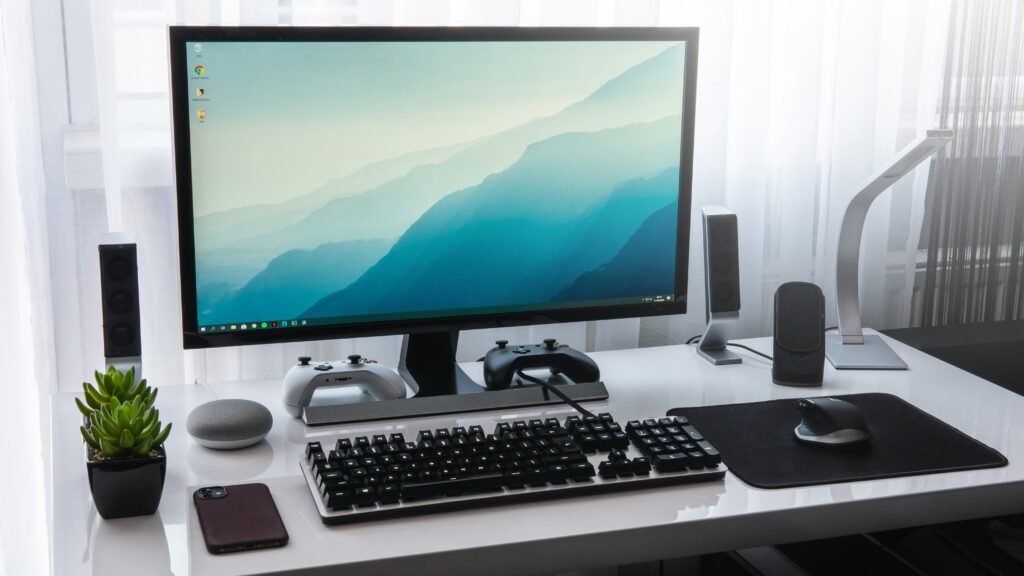
The top line of text should sit at or just below eye level, which is also what OSHA’s computer workstation guidance recommends, with the centre of the screen 15 to 20 degrees below horizontal and the screen 20 to 40 inches away. A stack of books costs nothing and tells you within a day whether you need a $40 (~£30) riser or a $110 (~£81) arm. Do this first, because it also changes which monitor is worth buying.
Fix the chair before the desk
Most desk-related back pain is chair-related back pain. A desk at the wrong height is uncomfortable and you notice it. A chair at the wrong height quietly decides how you sit for eight hours, and you notice that later.
Set desk height to your elbows, not to a number
Sitting upright, your forearms should be roughly level with the desk surface, the same neutral posture OSHA describes for workstation desks. Fixed-height desks are almost all built around 29 inches, which suits someone near 6 feet tall. If you are shorter than that, the chair goes up and a footrest comes in. That is cheaper than a new desk.
Light the desk from the side
A window or lamp behind you reflects off the screen. One directly in front makes you squint past it. Side light, ideally from a lamp you can angle, runs $25 to $90 (~£19 to £67) and does more for eye strain than any monitor setting.
Then buy the nice keyboard
Keyboards, desk mats, plants and cable management are real improvements to a day you can already work through comfortably. They are not fixes for a setup that hurts, and buying them first is how people end up with a beautiful desk they avoid.
The expensive version of this mistake: buying a sit-stand desk to solve back pain that came from the chair. A sit-stand desk is a good purchase for someone who already sits comfortably and wants to change position. It is a poor first purchase for someone who does not, because standing badly at the wrong height simply produces a different ache.
What a home office setup actually costs
Three home office setup builds, priced component by component so you can see where the money goes and stop at the row that matches your day.
| Component | Working minimum | All day | Dedicated room |
|---|---|---|---|
| Chair | $120 to $200 (~£89 to £148) | $300 to $500 (~£222 to £370) | $500 to $1,200 (~£370 to £888) |
| Desk | $80 to $150 (~£59 to £111) | $200 to $350 (~£148 to £259) | Sit-stand, $400 to $700 (~£296 to £518) |
| Monitor | 24in 1080p, $100 to $150 (~£74 to £111) | 27in 1440p, $200 to $300 (~£148 to £222) | 34in ultrawide or dual, $400 to $800 (~£296 to £592) |
| Screen height | Books, or a riser to $25 (to ~£19) | Monitor arm, $40 to $110 (~£30 to £81) | Dual arm, $110 to $220 (~£81 to £163) |
| Lighting | Desk lamp, $25 to $40 (~£19 to £30) | Angled lamp, $50 to $90 (~£37 to £67) | Lamp plus bias light, $90 to $200 (~£67 to £148) |
| Keyboard and mouse | $30 to $50 (~£22 to £37) | $80 to $150 (~£59 to £111) | $150 to $300 (~£111 to £222) |
| Total | $355 to $615 (~£263 to £455) | $870 to $1,500 (~£645 to £1,110) | $1,650 to $3,420 (~£1,221 to £2,531) |
Bands checked August 2026 against mainstream retailer listings in the US and UK, converted at $1 = £0.74. Sterling figures are a guide to scale rather than a UK retail quote, because the same model rarely sells at the converted price in both markets. Every total assumes you already own the computer.
The questions that decide the budget
Is a sit-stand desk worth it?
Worth it if you already sit comfortably and want to change position through the day. Not worth it as a fix for pain, because standing at the wrong height produces its own version of the problem. Most people who buy one settle at roughly an hour a day standing, which is a genuine improvement but a modest one for the price.
Do I need an ergonomic chair, or will a dining chair do?
For under two hours a day, a dining chair is fine. Past that, its fixed height and flat back start deciding your posture for you. The feature actually worth paying for is adjustable seat height, then adjustable armrests. Mesh, lumbar dials and headrests are much further down the list than the marketing suggests.
What monitor size suits a home office?
24 inches at 1080p for a short day, 27 inches at 1440p for a full one. Past 27 inches, resolution matters more than size: a 32 inch 1080p screen looks noticeably worse than a 27 inch 1440p one at the same viewing distance, because the pixels are spread further apart.
Should I buy the chair used?
The chair is the best used-market purchase in the entire setup. Office chairs are built for roughly a decade of daily use and get sold off in bulk when companies move or downsize, so a used one often costs about a third of new for the same model. Check the gas lift holds height and the armrests are present, because those are the two parts that are awkward to replace.
Does a second monitor actually help?
It helps if you regularly reference one thing while writing another, which is most office work. It helps much less if you work in one application at a time, where a single larger screen is usually the better spend. If you are unsure, try it with an old monitor or a laptop screen before buying a matched pair.
Go deeper on the desk itself
Two of the home office setup decisions on this page have a full guide behind them.