GLOBAL GUIDE · CHECKED SEPTEMBER 2026
Podcast Room Setup for a Small Room: Plan the Sound and the Shot Together
By Paul Maji · Updated 1 October 2026 · Research-led guide
The short answer: A podcast room setup in a small room comes down to four moves, in order: face into the room with something soft behind the camera, bring the mic to around 15 cm from your mouth, treat the first reflection points, then build depth behind you. Halving mic distance lifts your voice about 6 dB against the room in principle, for free. The rest costs under $290 at US retailers.
Every podcast room guide lists microphones, foam and a neon sign for the shelf. Almost none of them plan the room for sound and camera at the same time, which is the actual problem in a podcast room setup: the wall behind you is on screen, and it's also where your microphone is pointing.
Small rooms make it worse. You sit against a bare wall because it's the only space, and the recording sounds hollow and looks flat. Then foam goes up behind your head, the picture looks like a padded cell, and the echo barely moves.
The fix is mostly placement, not purchases. Where you sit, which way you face and how close the mic is decide more than any panel. This guide works from a room 2.15 m wide, the minimum single-bedroom width in the Nationally Described Space Standard (MHCLG, 2015), because a plan that works there works almost anywhere.
Four moves, in order, then a costed list of what to buy.
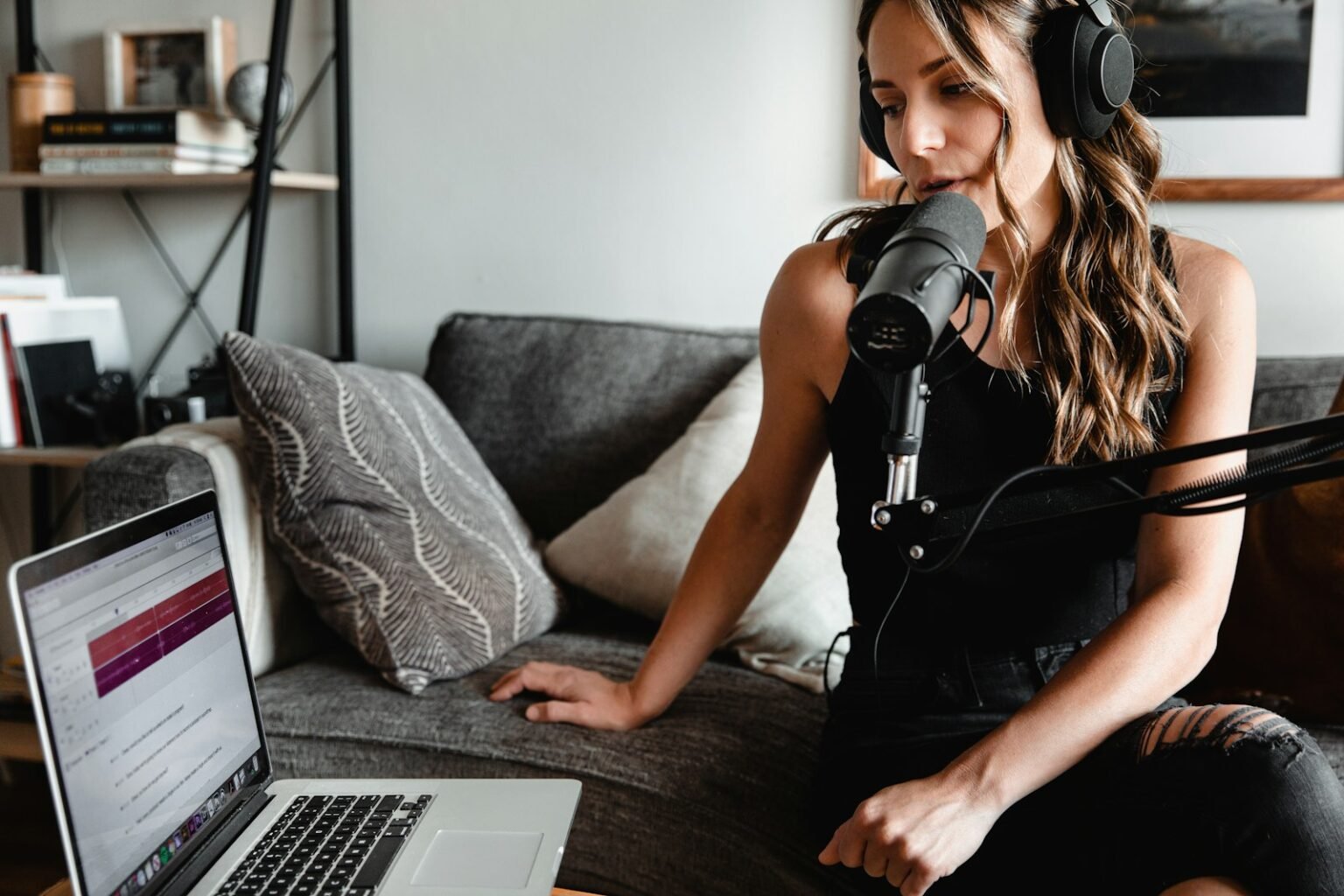
What's behind you matters twice
Most people plan the shot and the sound separately. In a small podcast room setup they're one job, because the same walls do both.
On camera, the wall behind you is the background. Acoustically, it's the surface your microphone is aimed at: a directional mic points at your mouth, and past your head the next thing on that line is whatever sits behind you.
The wall you face matters too, but differently. Your voice fires straight at it, so it sends a strong reflection back toward you and the mic. That wall is off camera, which makes it the right home for soft material that would look odd in shot.
So the plan splits cleanly. Soft and absorbent in front of you, behind the camera; layered and broken-up behind you, in frame. Two bare walls is the worst of both, and the default in most spare rooms.
The four moves in a podcast room setup, in order
A small podcast room setup comes down to four moves: face into the room with soft material behind the camera, bring the mic to around 15 cm, treat the first reflection points, and build depth behind you. Do them in that order. The first two cost nothing, and they fix more than the last two.
Four moves.
- Face into the room, soft wall behind the camera. Keep the longest clear distance in front of you and hang a blanket or heavy curtain on the wall behind the camera, which takes your voice head-on.
- Close the mic distance. Around 15 cm from mouth to mic, on an arm. The biggest gain in the list, and free.
- Kill the first reflections. Find them with a mirror, then cover those zones.
- Build depth behind you. A bookshelf, a small lamp and a darker background.
The order is deliberate, and it's the reverse of what most beginners do. Panels stuck behind your head go where the camera sees them and where your voice lands last; a blanket behind the camera goes where your voice lands first and the audience never looks.
If the camera position isn't settled, the podcast camera setup guide covers framing and camera height. Settle it before hanging anything.
Mic distance beats treatment
Moving a microphone from 30 cm to 15 cm from your mouth raises your voice by about 6 dB, while the level of the room's echo at the mic stays roughly where it was. In principle, that's a 6 dB better balance of voice against room, and it costs nothing but a mic arm.
The physics is the inverse square law. In a free field, sound intensity falls by 6 dB every time the distance doubles, as Sweetwater's June 1997 explainer on the inverse square law sets out. Halving the distance gives the 6 dB back.
Echo doesn't follow that rule. Reflected sound arrives from every wall at once, so its level barely changes when the mic moves. Your voice climbs; the room stays put.
Two caveats. A room isn't a free field, so treat 6 dB as the principle, not a measured result for your room. And most directional mics add bass as they get closer, the proximity effect, so a gentle low-cut filter helps at 10–15 cm.
A desk-stand mic at arm's length is two doublings from 15 cm, 12 dB lost in principle. A boom arm fixes that; check desk depth and arm clearance for a small room first.
Finding first reflections with a mirror
Think about a pool table. A ball hit at a cushion comes off at the angle it went in, and a decent player can point to the spot on the cushion that sends it into the pocket.
Your voice does the same off a flat wall. The first bounce from each surface reaches the mic a split second after the direct sound, close enough that it smears the voice rather than sounding like an echo. Those spots are the first reflection points.
Light follows the same angle rule, which is why a mirror finds them. GIK Acoustics' February 2026 guide to early reflection points describes the loudspeaker version: sit in the listening seat while a helper slides a mirror along the wall, and wherever you see a speaker is a reflection point.
For a podcast room the method is an adaptation, not the original. Your mouth is the source and the mic is the listener; with the two about 15 cm apart, marking where you can see the microphone from your recording position gets you close. Check both side walls, the desk top and the ceiling.
Treat the marks as zones, not dots. GIK makes the same point, so cover an area around each mark. For hanging blankets and panels without drilling, see the guide to no-drill acoustic treatment in a rented flat.
Soundproofing is a different job from treatment
Soundproofing stops sound getting into or out of a room and needs heavier, denser, more rigid construction; acoustic treatment controls echo and speech clarity inside it. A $9.99 moving blanket or a sheet of foam treats a room. Neither will stop a neighbour's dog or a passing bus reaching the mic.
That split comes from Primacoustic's May 2023 explainer on soundproofing versus sound absorption (updated July 2023), the distinction most podcast room ideas blur. Absorbers dissipate sound inside their fibres, so less of it bounces back.
Echo is measured as reverberation time, or RT60: how long a sound takes to fall by 60 dB once the source stops. NTi Audio's guide to reverberation time (undated, checked 25 September 2026) recommends 0.4–0.6 s for a classroom and 1.0–1.5 s for a lecture hall, so rooms built for clear speech sit at the short end.
So the question for a spare room is not how to block sound but how to stop your own voice bouncing around. For outside noise, record at quiet times and keep the mic close.
Boomy bass is a separate small-room issue, room modes in a small room, and matters more for mixing music than for speech.
Faking background depth in a 2.15 m room
Adam Irving's August 2017 interview guide for the International Documentary Association suggests a room deep enough to put the subject at least 10 ft (about 3 m) from the background, with the subject lit at least three times brighter than what's behind them.
A 2.15 m wide room doesn't have 3 m across its short side. Take off a desk and a chair and there's well under a metre behind your head. Depth has to be built, not found.
Four ways to fake it.
- Light the background less. The three-to-one ratio, roughly one and a half stops, works at any room size, and a darker background reads as further away.
- Add a practical lamp. A small lamp visible in a back corner gives the eye a point of light at a distance.
- Use a bookshelf, not a flat wall. Objects at different depths read as space, and they break up reflections.
- Angle across the diagonal. In a 2.15 m by 3 m room the diagonal is roughly 3.7 m, the longest line available. A corner shows two walls receding, not one flat plane.
The diagonal leaves distance in front of you too. Setting the three-to-one ratio with real lights is covered in the podcast lighting setup guide.
What a small podcast room setup costs, item by item
The core of a small podcast room setup costs under $290 at US retailers: a $9.99 moving blanket, $49.99 blackout curtains, a $79.00 BILLY bookcase, a $129.99 jute rug and a $19.99 work lamp, with prices checked 25 September 2026. The first two moves cost nothing, so spend only once the mic is close.
| Item | US price (checked 25 Sep 2026) | Job in the room | Verdict |
|---|---|---|---|
| FRANKLIN moving blanket, 72 x 80 in (about 183 x 203 cm) | $9.99, Harbor Freight FRANKLIN listing | Soft wall behind the camera | Yes |
| MAJGULL blackout curtains, 57 x 98 in | $49.99 a pair, IKEA MAJGULL listing | Window or the wall you face | Usually |
| BILLY bookcase, 15¾ or 31½ in wide, 79½ in tall | $59.00–$79.00, IKEA BILLY listing | Layered background and a broken-up rear wall | Yes |
| KALLAX shelving, 30⅛ x 30⅛ in or 30⅛ x 57⅝ in | $49.99–$79.99, IKEA KALLAX listing | Lower background shelf | Usually |
| LOHALS flatwoven jute rug, 5'3″ x 7'7″ (about 160 x 230 cm) | $129.99, IKEA LOHALS listing | Softens a hard floor; less useful on carpet | Usually |
| TERTIAL work lamp (bulb extra) | $19.99, IKEA TERTIAL listing | Practical light for depth | Yes |
| GIK Classic acoustic panel, 24 x 24 in (reference) | From $64.00 each, GIK Classic panel listing | Purpose-built absorber | Marginal as a first buy |
Metric sizes are converted from imperial listings. The panel is the upgrade once blankets show where treatment helps; buy it after the first three moves, not instead of them.
Plan the room before you buy for it
Three things carry most of the result. Mic distance comes first: around 15 cm gives your voice roughly 6 dB over the room in principle, for free. Soft material goes where your voice lands first, behind the camera, not behind your head. And depth behind you is built with light and layers, because a 2.15 m room will never give you the 3 m a documentary crew wants.
The next decision is the one this plan sets up: which camera angle and lights suit the layout you've just drawn. Fix your podcast room setup first and the kit choices follow. The podcast setup guide pulls those pieces together in the order to buy them.
Prices are US retail, checked 25 September 2026, and will change. SetupFind has not bench-tested these products; figures come from manufacturer specifications and named sources, as set out in how SetupFind researches its recommendations. Some links may earn a commission at no extra cost to you (affiliate disclosure).
Straight answers
How do I set up a podcast room in a small space?
Sit so the longest clear distance is in front of you, ideally across the diagonal, with something soft on the wall behind the camera. Put the mic on an arm around 15 cm from your mouth and cover the first reflection points a mirror reveals. A bookshelf and a small lamp behind you add depth on camera.
How do I soundproof a room for podcasting cheaply?
Real soundproofing isn't cheap, because stopping sound entering or leaving a room needs heavier, denser, more rigid construction (Primacoustic, May 2023). The cheap route is working around noise: record at quiet times and keep the mic close. Blankets and curtains fix echo, not outside noise.
Does a moving blanket or foam soundproof a room?
No. Both are absorbers that reduce echo by dissipating sound in their fibres; blocking sound through walls takes heavier, more rigid construction (Primacoustic, May 2023). A $9.99 Harbor Freight moving blanket (checked 25 September 2026) is an echo fix, not a soundproofing fix.
How far should my mouth be from the mic?
Around 10–15 cm keeps your voice well above an untreated room's echo. In a free field, sound drops about 6 dB each time distance doubles (Sweetwater, June 1997), so moving from 30 cm to 15 cm lifts your voice roughly 6 dB against the room in principle.
What should be behind me on camera?
A layered background such as a bookshelf, with a small lamp in a back corner, rather than a bare wall. Adam Irving's August 2017 guide for the International Documentary Association suggests sitting at least 10 ft (about 3 m) from the background and being lit at least three times brighter than it. In a small room, the lighting ratio does most of that work.