GLOBAL GUIDE · CHECKED SEPTEMBER 2026
Podcast Setup for 3 People: Preamps, Spacing and Headphones Before the Mixer
By Paul Maji · Updated 1 October 2026 · Research-led guide
The short answer: A podcast setup for 3 people needs three microphone preamps, not three inputs, plus a headphone feed for every host. The “four-input” Focusrite Scarlett 4i4 has only two preamps, so it can't do the job. Three current routes can: an Audient EVO 8 with a Behringer HA400 headphone amp (about $325), a Tascam Mixcast 4 ($499) or a RODECaster Pro II ($595). Complete three-person kits cost roughly $1,000–$1,270 (Sweetwater, checked 25 September 2026).
Every guide to a podcast setup for 3 people lists mixers, recorders and bundle deals. Almost none of them explain why the interface most people buy first, sold as “four inputs”, can only take two microphones. That one detail is what sends the third host back to a USB mic or a returns form.
The other gaps are just as practical. Bleed between three open mics gets treated as something to clean up in the edit, when most of it is decided by where the mics sit before anyone presses record. Headphones get a line at the end, even though the Scarlett 4i4 has one headphone output and the Audient EVO 8 has two.
This guide works through the problems in the order they actually arrive: preamp count, the three routes still in stock at a major US retailer, mic spacing, headphone distribution and gain. Then it prices complete three-person and four-person builds. If you're still at two hosts, the guide to recording a podcast with two people covers the step below this one. All prices are Sweetwater listings, checked 25 September 2026.
Tascam Mixcast 4
Why: Four preamps and four headphone outputs, each with its own volume, and it records to SD card without a computer.
Best for: three hosts in one room.
About $500 · price checked Sep 2026
Mic preamps, not inputs, decide a podcast setup for 3 people
Count mic preamps, not inputs. The Focusrite Scarlett 4i4 (4th Gen) has four inputs but only two microphone preamps, so it records two XLR mics, not three. A three-host show needs at least three preamps and a four-host show needs four, before headphones or software even come into it.
Focusrite's Scarlett 4i4 specification page (checked 25 September 2026) lists two mic/line/instrument preamps, one headphone output and a 69 dB gain range. The remaining inputs are line-level, with no mic preamp behind them. At $309.99 from Sweetwater (24 September 2026), it's the interface that ends up in a lot of three-host baskets by mistake.
Think of it as a car with four seats and only two seatbelts. On paper it carries four people. In practice, two of them are riding without the thing that makes the seat fit for purpose.
A microphone plugged into a line input is that unbelted passenger. A dynamic mic puts out a very small signal, and a line input expects something far stronger, so the recording comes back quiet, noisy or both. The seatbelt is the mic preamp: the stage that lifts a microphone's signal to a usable level.
The same trap catches the RODECaster Duo, listed at $498 by Sweetwater (checked 25 September 2026). It has two mic preamps, which makes it a two-host box, not a podcast mixer for 3 mics. If you're still deciding on the connection type itself, the XLR against USB microphone comparison explains why every route here is XLR.
Three routes to a podcast setup for 3 people that are in stock
Three routes still in stock handle three or four microphones: an Audient EVO 8 interface plus a Behringer HA400 headphone amp for about $325, a Tascam Mixcast 4 at $499, or a RODECaster Pro II at $595 (Sweetwater, checked 25 September 2026). Each one has four mic preamps.
| Route | Price (Sweetwater) | Mic preamps | Headphone outputs | Records without a computer | Verdict for 3 hosts |
|---|---|---|---|---|---|
| Audient EVO 8 + Behringer HA400 | $299.99 + $24.90 | 4 | 2 on the EVO 8; 4 via the HA400 | No | Yes, cheapest |
| Tascam Mixcast 4 | $499.00 | 4 combo | 4, each with its own volume | Yes, to SD card, up to 8 sources | Yes, default pick |
| RODECaster Pro II | $595.00 | 4 | 4 | Yes | Usually; best with SM7Bs |
| Focusrite Scarlett 4i4 4th Gen | $309.99 | 2 | 1 | No | No |
| Zoom PodTrak P8 | Last listed $349.99 | 6 | 6 | n/a | No, no longer available |
The Mixcast 4 is the default for most three-host shows. Tascam's listing at Sweetwater shows four combo mic inputs, four headphone outputs with individual volume, multitrack recording to SD of up to eight sources, USB audio interface mode, Bluetooth and mix-minus for a remote guest. It records with the laptop closed, which removes the most common point of failure on recording day.
The EVO 8 route wins on price if a computer is always at the table. The EVO 8 sends each of its four preamps to its own track in your recording software; the catch is its two headphone outputs, fixed for $24.90 with the HA400.
The RODECaster Pro II costs $96 more than the Mixcast 4. RØDE's RODECaster Pro II specification page (checked 25 September 2026) lists four combo inputs with 76 dB of preamp gain, four headphone outputs and multitrack recording to microSD, USB storage or a computer. That gain figure matters if SM7Bs are in the plan.
One warning about older advice. Both Zoom PodTraks, still recommended by many ranking pages, were marked no longer available at Sweetwater on 25 September 2026: the PodTrak P8 with six mic inputs, last listed at $349.99, and the PodTrak P4, last listed at $169.99.
Where the mics go: the 3:1 rule applied to talk
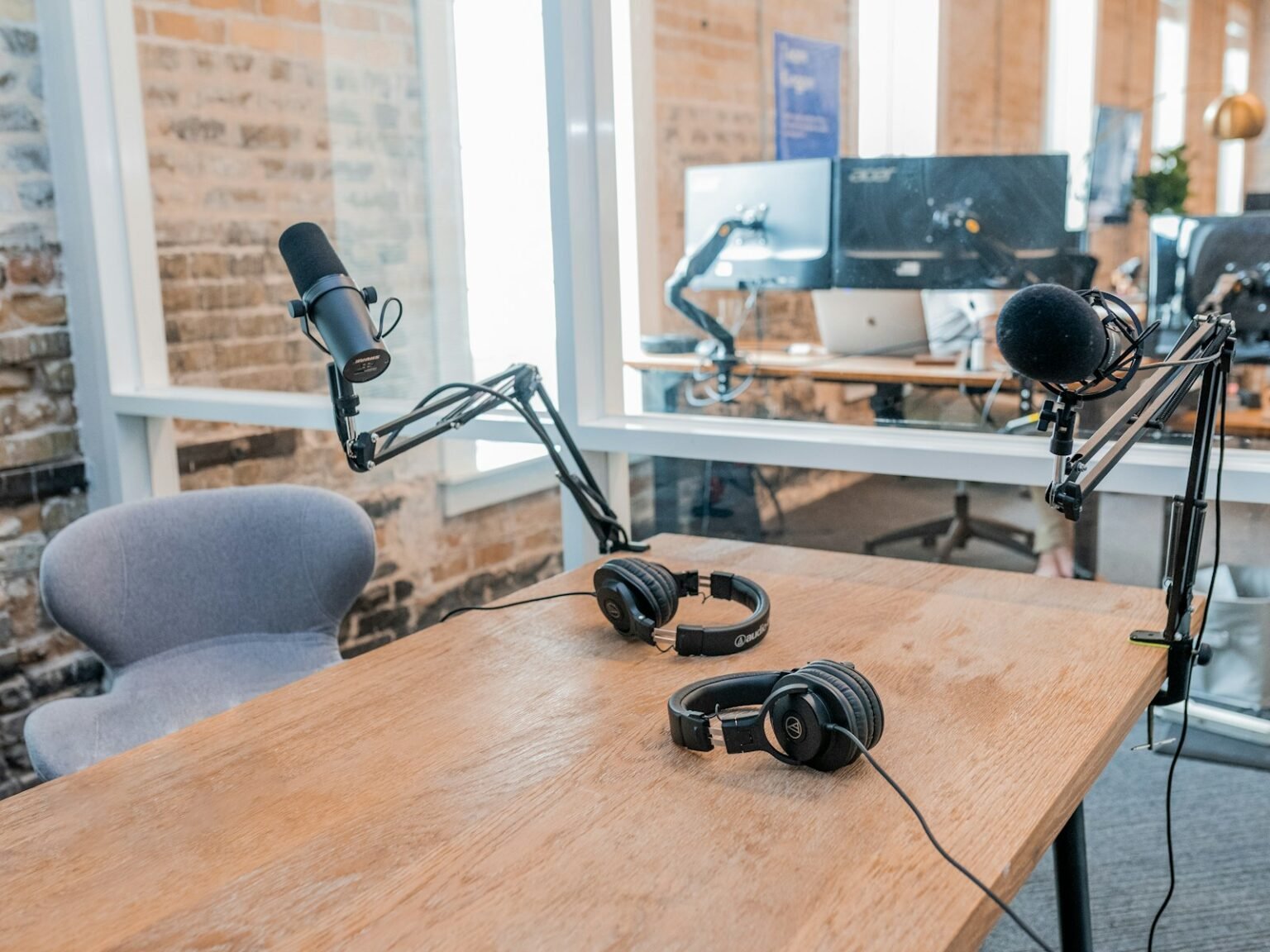
Bleed isn't an editing problem but a seating problem. With three open mics in one room, each mic hears the other two hosts slightly late, and that smeared, hollow sound is very hard to remove afterwards. Most of it is settled by distances you can measure with a tape.
Shure's guide to miking a choir (18 May 2009) sets the gap between microphones at roughly three times the distance from each mic to its source: the 3:1 rule. It was written for choirs, so this is an application to speech rather than Shure's own podcast advice. The principle carries over because talk is louder and closer to the mic than a choir.
The maths is simple. If each host sits about 10 cm from their mic, the mics want to be at least 30 cm apart; at 15 cm, at least 45 cm. Moving mouths closer is cheaper than moving chairs further apart.
Three placement rules.
- Sit in a triangle, facing inward. Each host can see the other two, which keeps talking natural without anyone leaning off their mic.
- Point the back of each mic at the other hosts. Shure's polar pattern basics article (June 2026) notes cardioid mics reject most at 180 degrees off-axis, directly behind the capsule.
- Use dynamic cardioid mics on boom arms. Arms hold each mic at a fixed distance from its host, so the 3:1 gap survives the whole episode.
The room still counts. Hard walls bounce voices back into every mic, so the podcast room setup guide covers layout, and the no-drill acoustic treatment guide for rented flats covers soft surfaces that don't cost you a deposit.
Headphones for every host
Every host needs their own headphone feed, and closed-back headphones stop that feed leaking into the mics. The Tascam Mixcast 4 and RODECaster Pro II each have four headphone outputs; the Audient EVO 8 has two, so a $24.90 Behringer HA400 amplifier splits one output into four.
Headphones let each host hear the recording as it's being made: levels, a plosive, someone drifting off their mic. Without them, one person monitors and the other two work blind; with them, everyone can correct their own position mid-sentence.
The EVO 8 setup takes two minutes. Run one EVO 8 headphone output into the Behringer HA400 four-channel headphone amp ($24.90, Sweetwater, 24 September 2026), then plug each host into the HA400. Everyone hears the same mix, each with their own volume knob, which is fine for a talk show.
Choose closed-back headphones, not open-back. Open-back designs leak sound, and a mic 10 cm away will pick it up. The Audio-Technica ATH-M20x is a closed-back option at $59 (Sweetwater, 24 September 2026).
Why the SM7B is the wrong budget mic here
The Shure SM7B is the mic pictured on most podcast pages. On a three-host budget, it's also the one most likely to cause trouble, and the reason is gain, not sound.
Shure's SM7B setup guide (7 November 2023) describes it as a low-output mic that wants around +60 dB of clean gain. RØDE lists 76 dB on the RODECaster Pro II's preamps, which covers that on paper. For any other box, check the specification sheet for a gain figure before pairing it with SM7Bs, and don't assume maximum gain is clean gain.
Cost settles it for most shows. At $439 each (Sweetwater, 24 September 2026), three SM7Bs cost $1,317 before the interface; three Rode PodMics at $86 each cost $258. The Shure SM58 at $109 is the other sensible budget dynamic.
Set gain with each host talking at their loudest, laughing included, then back off until nothing clips. Record every mic on its own track so a loud laugh on one channel never costs you the other two.
What a podcast setup for 3 or 4 people costs
A complete podcast setup for 3 people costs about $999 on the Audient EVO 8 route and about $1,173 with a Tascam Mixcast 4, using Rode PodMics, boom arms, XLR cables and closed-back headphones (Sweetwater, 24–25 September 2026). Each extra host adds $224.64.
Four items per host, priced at Sweetwater on 24 September 2026.
- Rode PodMic, $86. Dynamic cardioid; swap to an SM58 for $109.
- On-Stage MBS5000 boom arm, $45.65. Holds the mic distance steady; the Rode PSA1+ at $129 is the sturdier upgrade.
- Pro Co EXM-20 XLR cable, $33.99. One per mic, from the mic to the box.
- Audio-Technica ATH-M20x, $59. Closed-back, so the feed stays out of the mics.
| Build | 3 people | 4 people | Verdict |
|---|---|---|---|
| EVO 8 + HA400 ($324.89) | $998.81 | $1,223.45 | Yes, if a computer is always there |
| Tascam Mixcast 4 ($499) | $1,172.92 | $1,397.56 | Yes, default pick |
| RODECaster Pro II ($595) | $1,268.92 | $1,493.56 | Usually; worth it for SM7Bs |
A podcast setup for 4 people uses the same boxes, because all three have four preamps. That's also the ceiling: a fifth host means a bigger mixer, not a workaround. The totals leave out a computer, SD card and room treatment.
Preamps first, then seating, then headphones
Three things decide whether a podcast setup for 3 people works. Count mic preamps before anything else, because a “four-input” interface with two preamps records two people. Fix bleed with seating and the 3:1 rule, not in the edit. And give every host their own closed-back headphones, through built-in outputs or a $24.90 splitter.
The next decision is whether a computer should sit at the table. If it always will, the EVO 8 route saves about $174 on the three-person build. If you'd rather record with the laptop closed, the Mixcast 4 is the better spend. For microphones, cameras and rooms beyond the mixer question, the podcast setup guide maps the rest of the build in order.
Prices are US retail, checked 25 September 2026, and will change. SetupFind has not bench-tested these products; figures come from manufacturer specifications and named sources, as set out in how SetupFind researches its recommendations. Some links may earn a commission at no extra cost to you (affiliate disclosure).
Straight answers
Do I need a mixer or an audio interface for a 3-person podcast?
Either works, as long as it has at least three mic preamps and enough headphone outputs. An Audient EVO 8 interface ($299.99 at Sweetwater, checked 25 September 2026) records to a computer, while a Tascam Mixcast 4 ($499) records to an SD card on its own. Choose the Mixcast if you want to record without a laptop.
Can a Scarlett 4i4 record 3 or 4 microphones?
No. Focusrite's specification page for the Scarlett 4i4 4th Gen lists two microphone preamps; its other inputs are line-level. It records two XLR microphones, so a three- or four-host show needs an interface with four preamps, such as the Audient EVO 8.
How far apart should the mics be on a 3-person podcast?
Apply Shure's 3:1 rule, from its 2009 guide to miking a choir: keep mics about three times further from each other than each mic is from its speaker. With hosts 10 cm from their mics, that means at least 30 cm between mics. The rule was written for choirs, but the same principle applies to speech.
How do I give everyone headphones on a 3-person podcast?
Use a box with an output per host, or add a headphone amplifier. The Tascam Mixcast 4 and RODECaster Pro II each have four headphone outputs. The Audient EVO 8 has two, so feed one into a Behringer HA400 ($24.90 at Sweetwater, 24 September 2026) for four outputs with individual volume.
Should each person be on a separate track?
Yes. Separate tracks let you fix one host's level, cough or laugh without touching the other two voices. The Audient EVO 8 sends each mic to its own track in recording software, and the Tascam Mixcast 4 and RODECaster Pro II both record multitrack without a computer.